Check whether the biomarker identifies patients who benefit before changing the next study.
Find who benefits before changing the study.
Compare the marker results, explain what remains uncertain, and let scientific leaders decide what to test next.
Start with
Lab tests, samples, and study results
Prepare
What the marker shows and what to check
Team decides
Scientific leaders choose who to include
How it works.
01
Reconstruct the marker definition across the study record.
Agents trace assay versions, cutoffs, sample availability, and analysis history, including choices made after results were seen.
Original rationale
Selection memo · 2018
70% response above the threshold. 40% below.
The threshold was chosen after seeing the outcomes.
Lab bridge · 2020
The later test scores the same specimens 20 points higher.
Same threshold, different scales
Assay A ≥60 → Assay B ≥80
02
Test the signal against patient and study evidence.
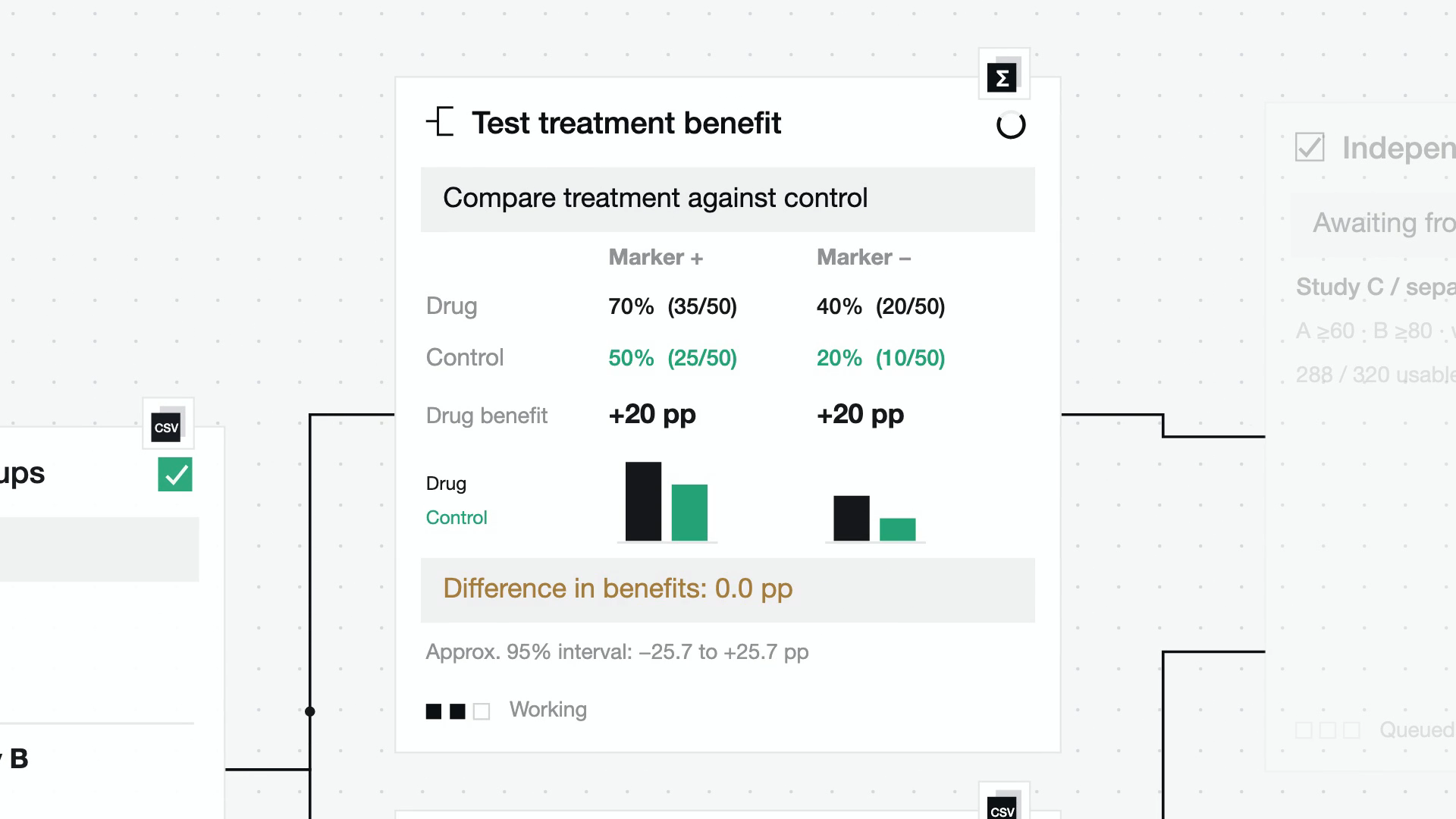
Agents connect marker results to drug and control outcomes, account for missing samples and measurement differences, and surface other explanations for the pattern.
Study B · week 16 responses
Treatment
Marker +
Marker −
Drug
70% 35 / 50
40% 20 / 50
Control
50% 25 / 50
20% 10 / 50
Drug benefit
+20 points
+20 points
Extra benefit for marker + is unproven.
Difference: 0.0 points 95% interval: −25.7 to +25.7 points
Separate study · rule fixed beforehand
Study C: difference −1.4 points 95% interval: −22.8 to +20.0 points
03
Prepare an independent validation plan.
Agents lay out the assay, cutoff, evidence gaps, and criteria to test. Scientific leaders decide whether the marker should change the study population.
Study drafts
Clinical Development + Biostatistics
Keep both marker groups.
Before
Marker-positive only
After
Include both marker groups
Analysis
Test whether drug benefit differs by marker group.